

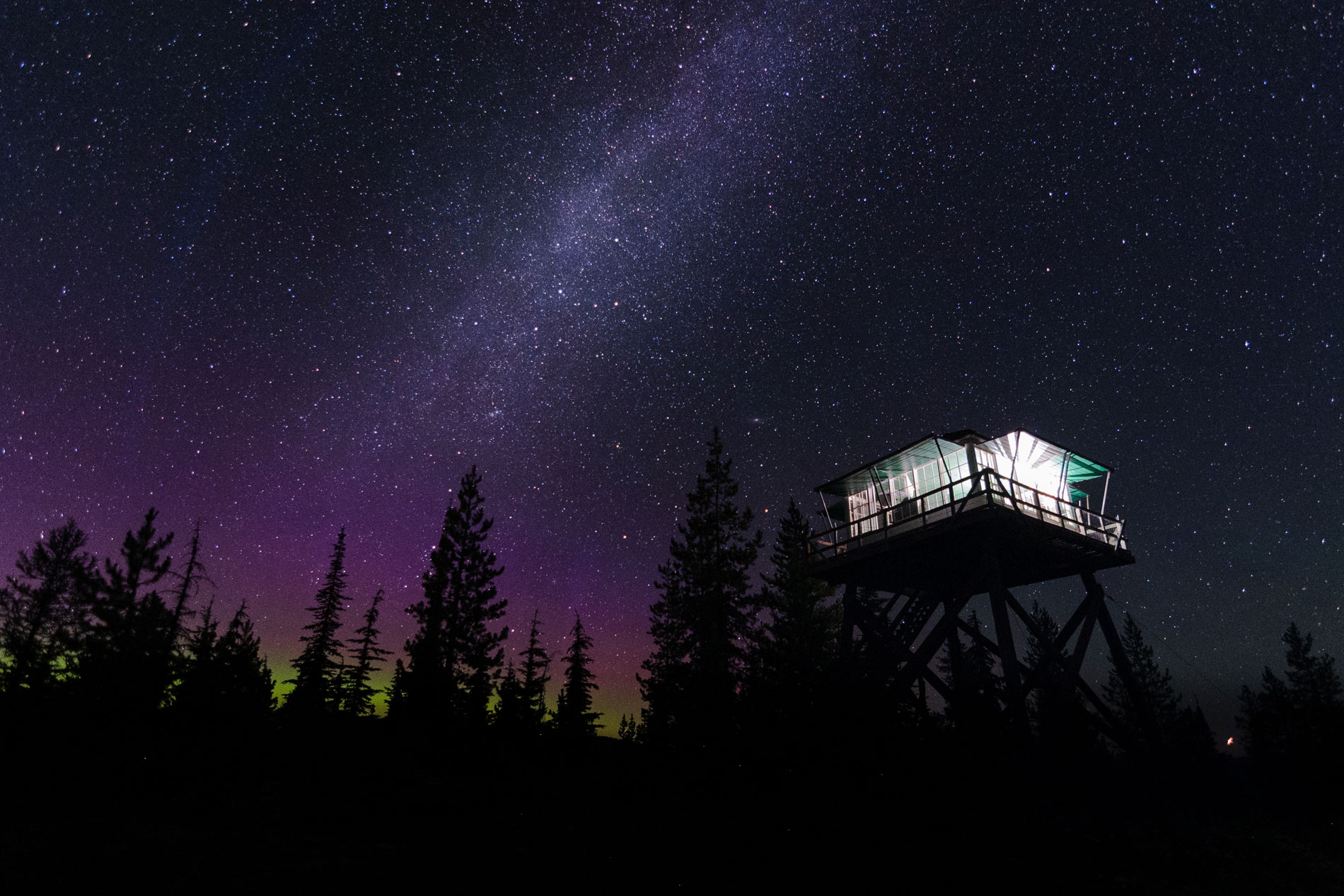
A cool summer night breeze nipped at us as we stood on Arid Peak Lookout’s catwalk. We continued to watch while pulling our jackets tighter and readying our cameras. Then we saw it and were frozen in awe at the ribbons of green and pink aurora that danced in the night sky to the north of us over Idaho’s St. Joe mountains. What started as a weekend getaway to explore a local historic site quickly became an unforgettable front-row seat to nature’s spectacular midnight show. By the end of the weekend, we’d face lightning storms, wildfires and a taste of what it truly meant to be fire lookouts.
Built in 1934, Arid Peak Lookout sits on a lower ridge in Idaho’s St. Joe National Forest, unlike most towers built on the highest peaks. Arid’s purpose was unique to watch for spot fires ignited by sparks from the Milwaukee railroad as its trains lumbered through the dense forest below. The electrified railroad ran through this section of forest, linking parts of the Montana line to the North Fork of the St. Joe River at Avery, Idaho. The train is gone, the tracks removed long ago, and the rail bed has been reborn as the Hiawatha Bike Trail, attracting thousands of visitors annually.
From the catwalk where the trains’ roar shook the air, we only heard the forest whispers and nature’s unique symphony. The towers’ legs were replaced in 1969, but the lookout was not actively used in service again. Some of these historical monuments to our past are destroyed or have fallen into an unsalvageable level of disrepair. Arid was given a new lease on life. In 1996 and 1997, the FFLA and the St. Joe Ranger District joined in a restoration project; they replaced all of the beams atop the legs and underneath the cab and the stairs, which had collapsed in 1970. Added to the rental program, Arid now lives a second life as a rustic refuge to modern adventurers, offering a unique place to stay and a glimpse into a bygone era.
Me, along with fellow lookout enthusiast Cat House, and our friend Jim Stoner, had reserved the lookout six months prior and eagerly awaited this escape into the wilderness. The hike wasn’t challenging — just three miles and about 600 feet of elevation gain — but it certainly felt more difficult than expected. Perhaps it was the heat or the months we’d spent away from our usual hiking routine, but each uphill stretch felt more challenging than expected. Typically, when hiking to a lookout, we are motivated by the distant view of our destination, a visual goal to push forward. But this is something that Arid Peak did not provide. This unique lookout kept its location secret, obscured by the terrain and the surrounding forests until we were less than 100 yards away.
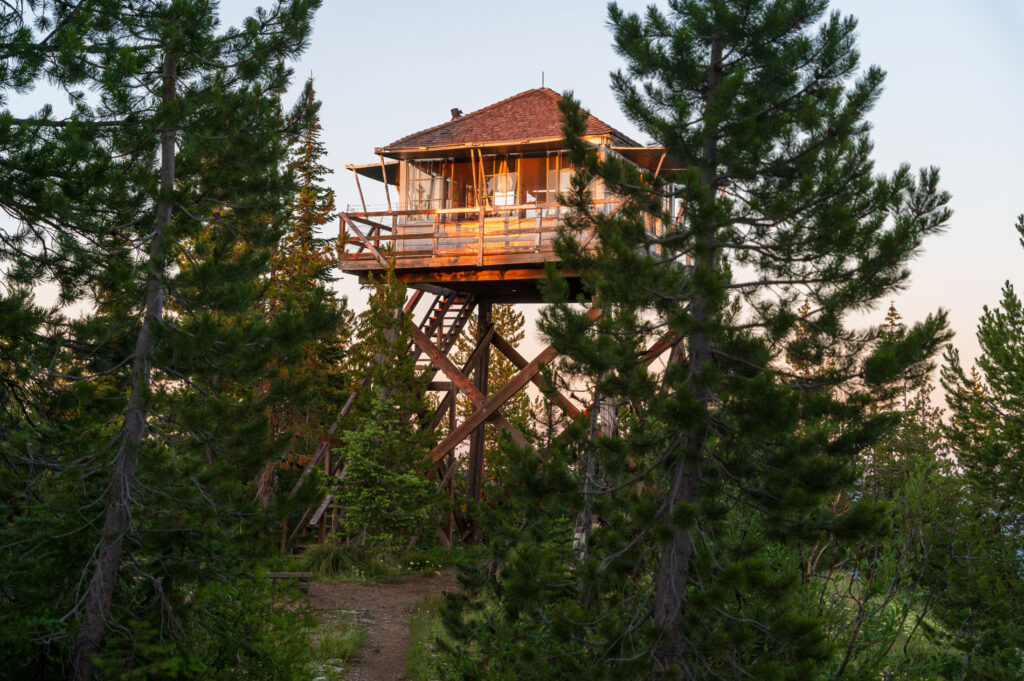
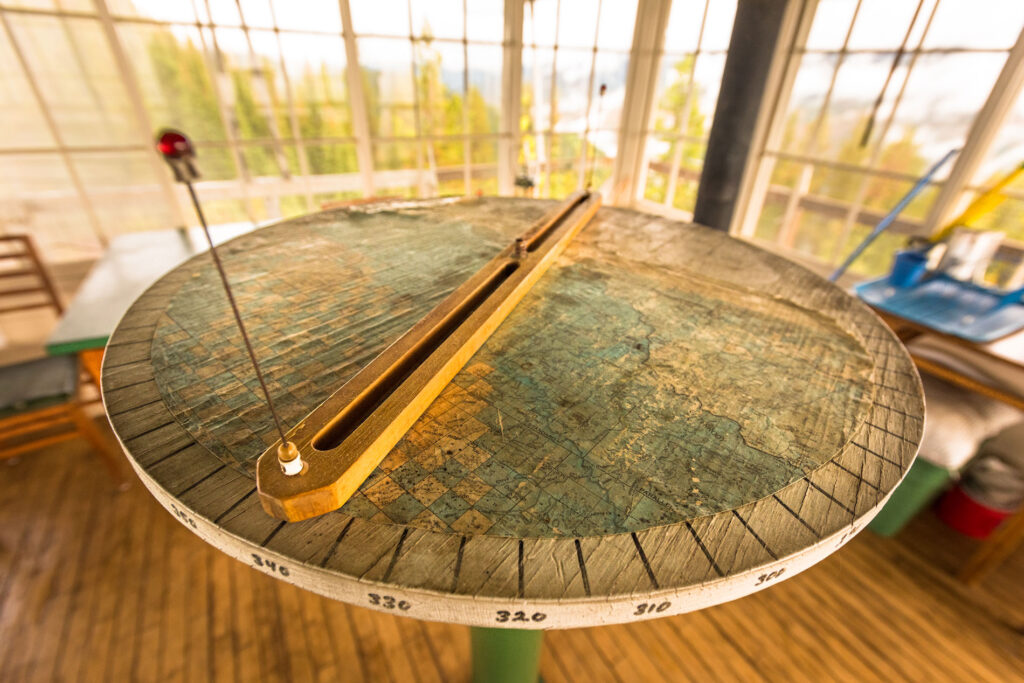
Finally stepping into the clearing, the lookout appeared abruptly, the cab and surrounding catwalk perched high upon its stout timber frame. The structure was modest and worn yet welcoming. A steep staircase, narrow catwalk, and compact interior greeted us, complete with a small table, shelves, a wood stove, and beds uniquely framed in metal. Unlike many lookouts flanked by steep cliffs and little ground to maneuver, Arid Peak’s more spacious ridge includes a cozy fire pit and paths to the outhouse and around the hilltop marked by carefully placed rocks.
After unpacking, Cat soon prepared a homemade backpacker’s feast, filling the small lookout with a mouthwatering aroma as dinner sizzled on the propane stove. As we enjoyed dinner, we couldn’t help but discuss the aurora predictions we had read. Strong auroras are an uncommon event at our latitude, and rumors were that a solar storm had erupted a few days earlier, and we might be lucky enough to experience one of nature’s greatest shows. As twilight faded and stars slowly appeared in the night sky above, we remained skeptical yet hopeful as we mounted our camera on our tripods and prepped our gear.
At first, the northern sky seemed quiet. We had hauled our cameras, tripods, lenses, and other gear up the steep mountain trail, only to be disappointed. But a test shot changed everything. After a few seconds of pointing at the dark sky, the digital screen on the back of the camera revealed a faint green glow. A sight too dim for the naked eye but enough for the camera’s sensitive sensor to capture the aurora for the first time that evening. It would be an understatement to say we felt a surge of excitement as the aurora intensified, stretching vividly toward the heavens, intermingling with the arch of the Milky Way. Jim, already fast asleep, was roused from his sleep by my and Cat’s enthusiastic screams of excitement at the celestial show beginning above.
The sky teased us with quiet moments of darkness before exploding again with vibrant color and brilliance. Each time we were about to give in and accept that the show had ended, it pulsed alive one more time. For hours, we ran all around the lookout, attempting to capture images we could hang on our walls to become treasured keepsakes, vividly documenting one of the most thrilling experiences of our lives.
We awoke the following day, bleary-eyed and tired, the night’s late aurora having stolen many hours of sleep from us. At the same time, I muttered and grumbled about my deflated air mattress, leaving me to sleep directly on the catwalk’s weathered and unforgiving timber planks. After shaking off our fatigue, we hiked back to our car to explore the St. Joe Forest’s logging past. We went up Marble Creek and over to the Hobo Cedar Grove. As we trekked the path that slowly descends to the creek below, we immersed ourselves in the area’s logging history. Long ago, the area was littered with logging camps, where hundreds if not thousands of men spent the summers in the forest felling trees and sending the precious timber careening through the forest on flumes as they snaked down mountains to the waterways that would eventually carry the precious timbers to log mills.
Our first stop was an abandoned steam donkey. Now just a sizable rusted hunk of metal with parts hanging off, the massive machine was discarded in the woods. Like kids playing make-believe, it’s easy to lose yourself in a world of imagination, where you pull the machine’s giant levers to control the massive cable that snakes through the woods, pulling gigantic fallen timbers across the forest floor. Next, we found the camp, its crumbling cabin foundations and scattered remnants forming a ghost town that echoed the hard labor that was the daily life of the men who lived deep in the forest.
Tired from our exploration and the miles of dirt under our boots, we headed back to Arid Peak Lookout, our rustic mountain home, for one more night. By the time we hiked back to the peak, exhaustion overtook us, and everyone needed a nap. We all found a comfortable and relaxing spot to rest while listening to the trees rustling in the breeze and birds chirping.
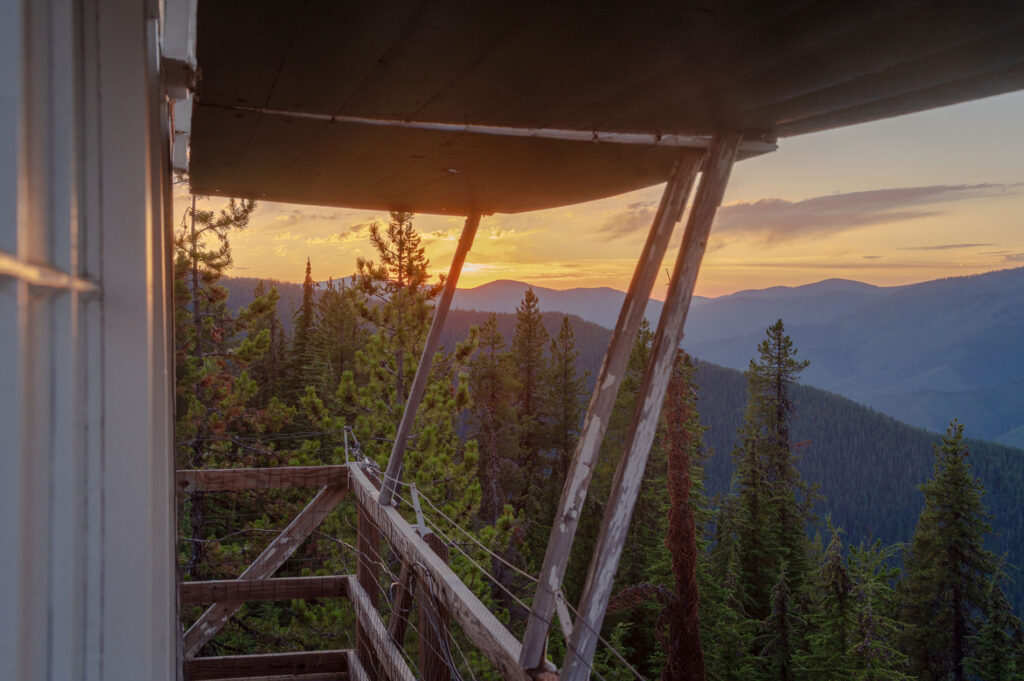
The evening brought quiet conversation, a hearty dinner, and early rest, at least until flashes of lightning and rumbles of distant thunder jolted us awake. Initially far off, the storm moved closer, lighting the lookout’s interior in eerie, fleeting bursts. Most fire towers feature glass-insulated chairs for safety during lightning storms; Arid Peak lacked these. Instead, metal-framed beds attached to the tower’s network of copper grounding wires became our temporary haven as we nervously perched atop mattresses, carefully avoiding touching conductive surfaces. Lightning danced around us, illuminating the surrounding wilderness. We gasped as distant air-to-ground strikes ignited three separate fires, their flames flaring against the dark horizon. We felt a profound connection to the lookout’s original purpose in those thrilling moments. We became genuine fire lookouts for those adrenaline-fueled hours, the wilderness ours to protect.
When we woke at dawn, we noticed smoke still lingered from one of the lightning strikes. We had escaped the cell signal long ago and did not have a way to call in the remaining fire. We could only note the fire’s approximate location, and scribbled some notes on its location before locking up the tower and hiking out.
Driving home, we flagged a passing Forest Service crew and handed over our scribbled notes and coordinates of the fire. For a fleeting moment, their thanks was like a badge of honor, an acknowledgment that more than 50 years after retirement, Arid Peak once again stood sentinel over the forests below, this time with us on patrol. It isn’t the tallest or grandest lookout we’d seen, but it offered us a rare gift: a chance to live its history. We’d come for escape; we left with a story etched in us that we would never forget. n
Cat House contributed to this article. Billy Cooter and Cat House, founders of Idaho Fire Lookouts, share images and stories of Idaho’s fire lookout towers at www.idahofirelookouts.com.
As seen in the 2025 Summer/Fall edition
By: Billy Cooter